I started coding in then 1960’s on a Ferranti Mercury. It was as big as a house and had less computer power than my watch. But at the time we thought it was pretty cool. Over the years, Moor’s Law turned out to be pretty accurate. The most powerful computers doubled in power about every two years. Commercial systems got smaller. From as big as a house, to the size of a room, to the size of a desk, then a largeish box in a rack.
But in the mid 1970’s something happened off the Moore’s Law track. They managed to fit all the components of a low-power computer on a single chip. They were mass produced and relatively cheap. The engineers that built it had in mind using them for process control, calculators or computer terminals.
Enter Gary Kildall

But a genius called Gary Kildall saw another potential use for these devices.
He created a programming language and an operating system that allowed you to control, a simple disk drive and printer . This meant that you could create a low-power general purpose computer very cheaply using mass-produced components. He was contracted to Intel, who bought the programming language, but couldn’t see the market for a computer based around their chip and rejected the operating system. Gary went on to market it under the name CP/M – Control Program for Micros.
It turned out that the market for a small cheap computer was massive. People everywhere were discovering that with this new technology they didn’t need an expensive mainframe to do day to day tasks. The business took off like a rocket. Small companies sprang up to manufacturer small computers using the new chips and running CP/M.
So CP/M was quite successful. Gary Kildall was arguably the father of the personal computer, and should be as well known as Bill Gates. (arguably instead of Bill Gates, but that is another story).
My Apple II
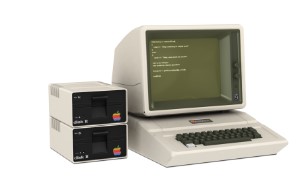
(including floppy disk drives)
At that time I was working in New York for a British consultancy. One of my tasks was to create a business forecast for the each year. I rented time on a computer (kind of like cloud computing) and created the forecast using a language called LISP1. It took a long time and the bureau charged us a little over a grand for the computer time.
The following year I acquired an Apple II computer2 with a spreadsheet called VisiCalc. It took a lot less time and the whole computer cost less that I had spent at the bureau the previous year. As a bonus I could use the computer all year.
The computer was low-power, but it was powerful enough for many day-to-day tasks. We were saving a ton of money each time I used it.
When I got back to the UK, I homed in on a Superbrain computer in the ofice that nobody else was using. I didn’t need to use the typing pool to product reports, I typed them myself. Instead of sitting round waiting for a spelling mistake to be fixed by the typists. I just tapped on my keyboard and hit ‘print’. This was not an approach that everyone took up. Typists were low-grade staff, so doing their work was to lose status. I was ahead of the curve: typing pools are history.
These days we think of computers as those boxes on our desks or stacked up in a rack. But it wasn’t always like that. Hats off to Gary Kildall.
- Some say LISP stands for Lots of Incredibly Stupid Parentheses, it actually means LIst PRocessing.
- As it happens Apple didn’t use CP/M like the rest of the industry, they went off on their own, setting a pattern for the next half century. And they had a huge advantage over the rest of the industry – VisiCalc was unique.
 Bob Browning's blog
A bit weird to say “created a programming language and an operating system” and then not mention the programming language! It was PL/M, a PL/1 style hardware-specific language for the Intel 8008, written by Kildall for Hank Smith.
LikeLike